
ASL Video Translation 101: What It Is and How It Works
This is a more digitalized world, so now more than ever it is essential to make information more accessible to all. The American Sign Language (ASL) is a visual language that is rich and intricate and is the first language of many deaf and hard-of-hearing individuals.
The video translation technology in ASL is the most important to overcome the communication hurdles and enhance digital inclusion. The comprehension of this technology does not just lie in keeping pace with the latest technology, but is one of the requisite steps to be made towards a more accommodating world for all.
What is ASL Video Translation?
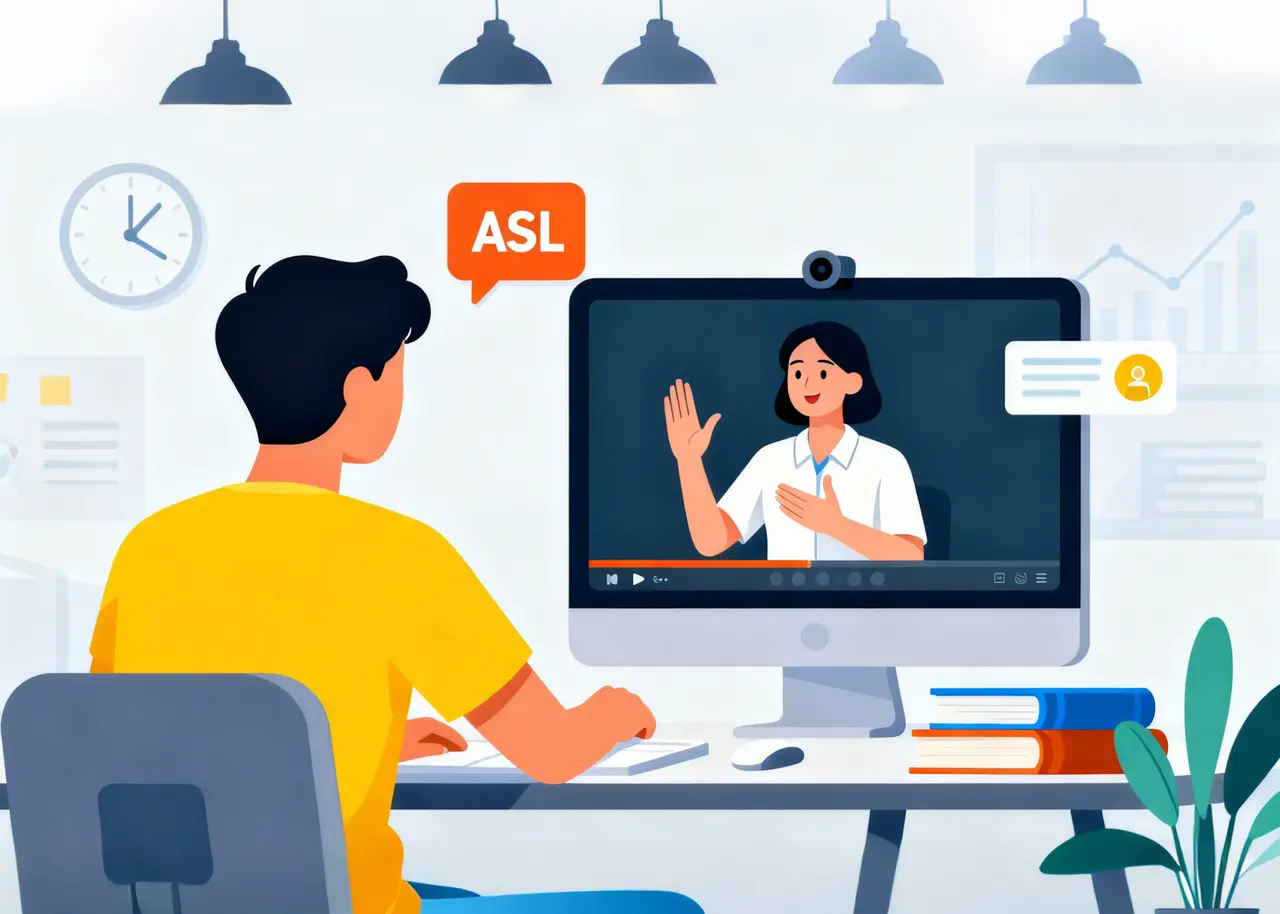
ASL video translation is a technology to convert American Sign Language (ASL) video material into text, or speech automatically with the use of computer vision and artificial intelligence. It is based on the power of empowerment; it can create bridges that are barrier-free in fields like online learning, at work communication, and in the entertainment sector in the media, where the deaf community can enjoy equal access to information and engage in social activities.
In order to better see this point, it is important to define translation and interpretation:
Altogether, the ASL video translation is mostly focused on asynchronous video materials, which can be searched and comprehended. The technical aspect of this automation is a workflow that is complicated and sophisticated.
Key Applications of ASL Video Translation
ASL video translation makes content accessible across various domains:
- Education: Multitrack lectures, tutorials, and e-learning materials into ASL to accommodate the Deaf students.
- Healthcare: Present medical instructions, the consent form, and health information in ASL to enable the patients to understand it.
- Business & Customer Service: Ensure accessible communication in meetings, presentations, and customer support.
- Media & Entertainment: A wider range of people can be reached with the help of ASL translations of subtitles and video content.
- Legal & Government Services: Make legal documents, court proceedings, and public announcements accessible in ASL.
How ASL Video Translation Works
ASL video translation is based on the combination of computer vision, machine learning, and linguistic rules to translate spoken or written language into correct American Sign Language video.
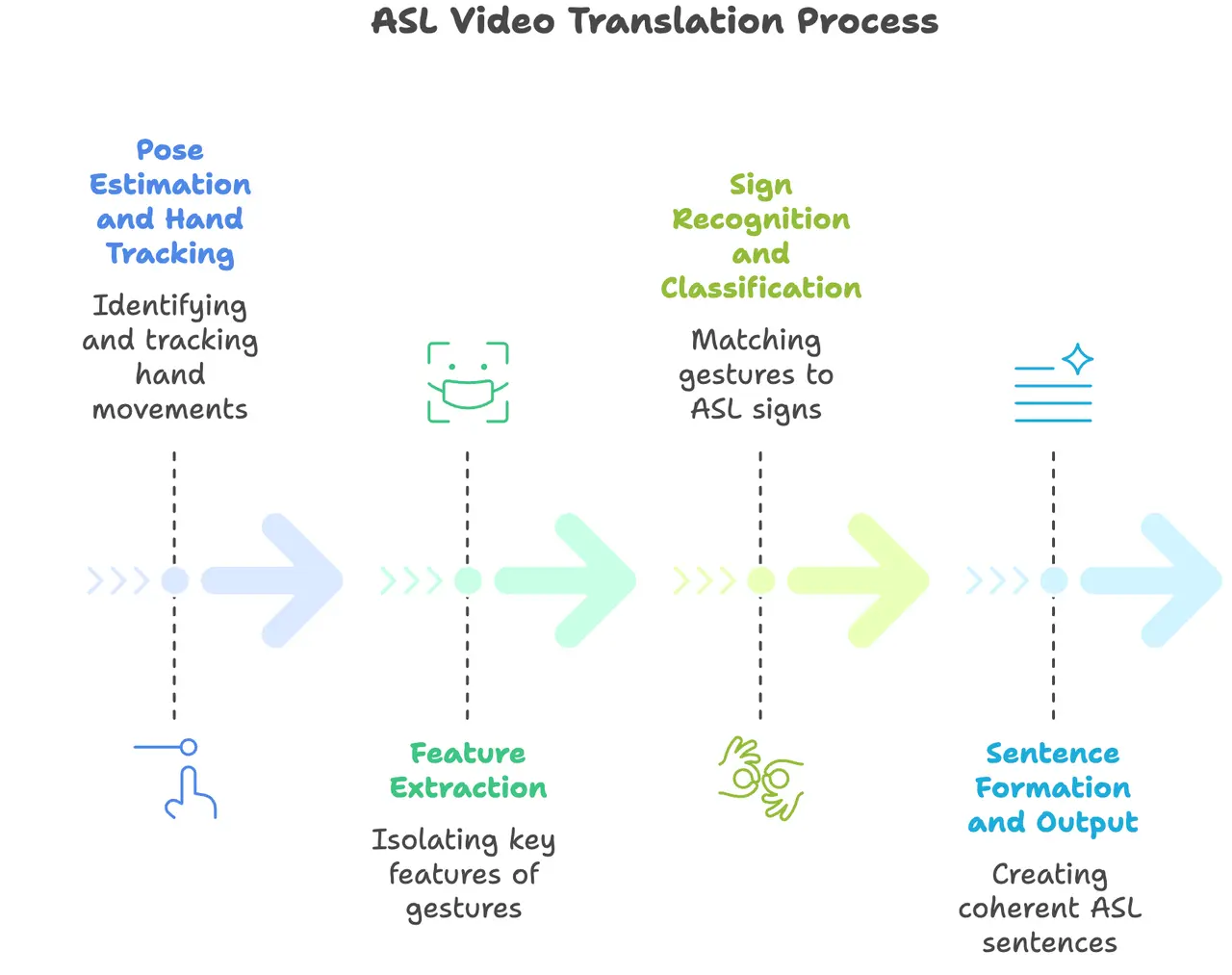
The process involves several steps, each crucial for ensuring that the translation is both precise and expressive. Here’s a breakdown of how it works:
Step 1: Pose Estimation and Hand Tracking
The first thing that the ASL video translation system does is to identify the individual in the video and correctly follow their hands. The system can determine important points like joints and fingertips of the fingers by using advanced techniques of computer vision and by ruling out other irrelevant background data. This makes every movement of the hands accurately tracked.
Step 2: Feature Extraction
After tracking the hands, the system isolates the features of the hands, face, and the general body stance. ASL particularly depends on facial expressions and mouth movement to express grammar, tone, and emotion. This measure will guarantee that little details in the gestures of the signer are captured to achieve proper translation.
Step 3: Sign Recognition and Classification
Machine learning is applied in this step. The features that are extracted are compared with a huge, pre-trained set of ASL signs to detect certain gestures or words. AI video translators like ScreenApp use these models to identify signs in real-time and guarantee the high accuracy of different hand shapes, movements, and expressions.
Step 4: Sentence Formation and Output
Lastly, the system brings together concrete understood signs into coherent sentences, which are in the ASL language instead of English syntax. The volume can be presented in the form of text, synthesized speech, or moving videos of ASL, and this allows communication among Deaf and hard-of-hearing users.
Challenges and The Future of ASL Video Translation
The video translation of ASL has developed at a fast pace, however, there are still challenges.
Challenges:
- Complexity of ASL: Dialects, styles, and slight facial expression makes it hard to translate properly.
- Data Requirement: AI training requires large and quality data.
- occlusion: Accuracy can be decreased by having hands or faces covered in videos.
Future Prospects:
- More sophisticated AI Models: More recognition and understanding of context.
- 3D Tracking: Captures depth and subtle movements more accurately.
- AR/VR Integration: Real-time, immersive communication possibilities.
- Real-Time Applications: Live translation in conversations or videos.
Regardless of the existing challenges, future innovations are likely to bring more inclusivity to the ASL communication.
Conclusion
ASL video translation is not only a technological invention, but it is a potent force that promotes social inclusion and equality. It creates an unparalleled interface between the hearing and the deaf community by rendering the language of the deaf community into a form that is easily understood in writing and speech. The possibilities of this technology are unlimited, although obstacles are still present.
We urge you to keep on following and advancing the invention of accessibility technology. Begin by using AI applications such as ScreenApp and feel the power of technology to enhance communication with others, and we can all be able to get to a more inclusive future.
FAQs
Can you translate ASL with a phone?
Yes, with the help of an experimental application, basic signs can be translated with the help of the camera of phone. Nevertheless, there is an ongoing challenge of translating entire, conversational ASL in real time, which is not yet precise as yet.
Is there an AI that can translate ASL?
Yes, with the help of AI-based ASL translators such as ScreenApp, users can analyze sign language videos with the help of advanced computer vision technology and convert them into text or speech, which increases digital accessibility.
How accurate is AI sign language translation?
In controlled environments, individual, pre-defined signs are accurate. Accuracy is reduced, and in the process of improvement, to accommodate diverse styles of signing, lighting, and complicated grammar to facilitate fluent and real-life conversation.